Mahsulot tavsifi
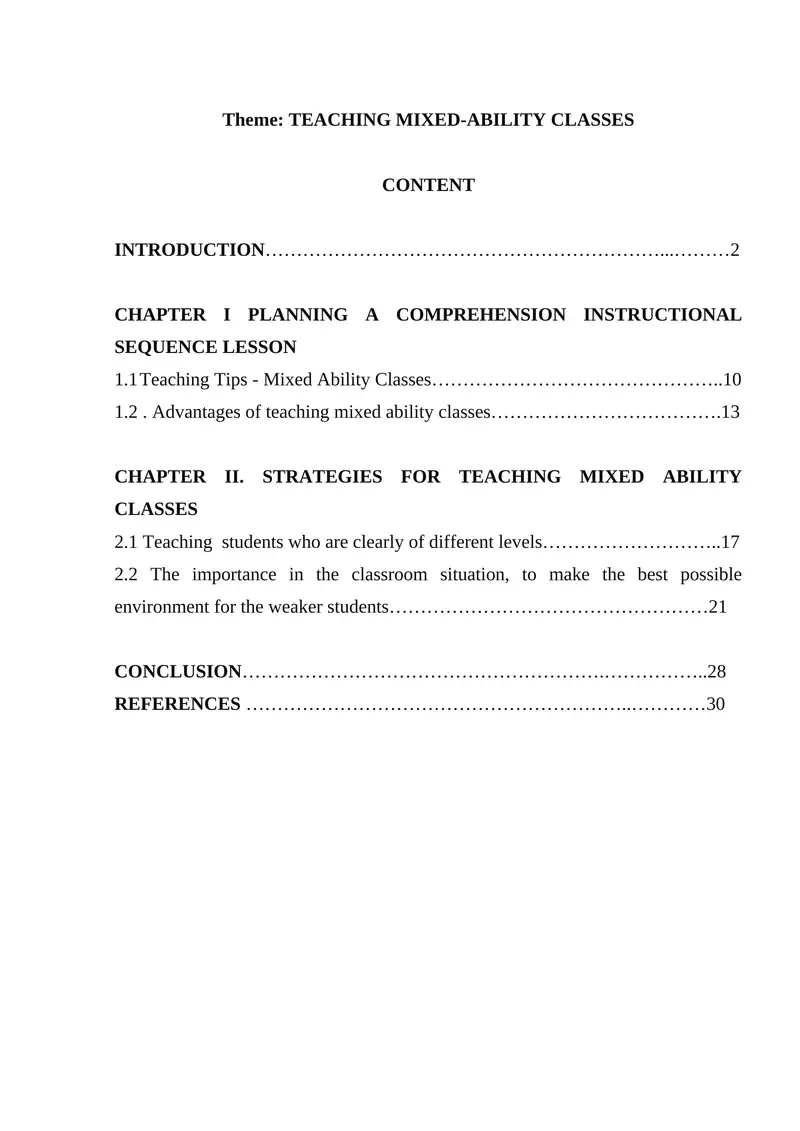
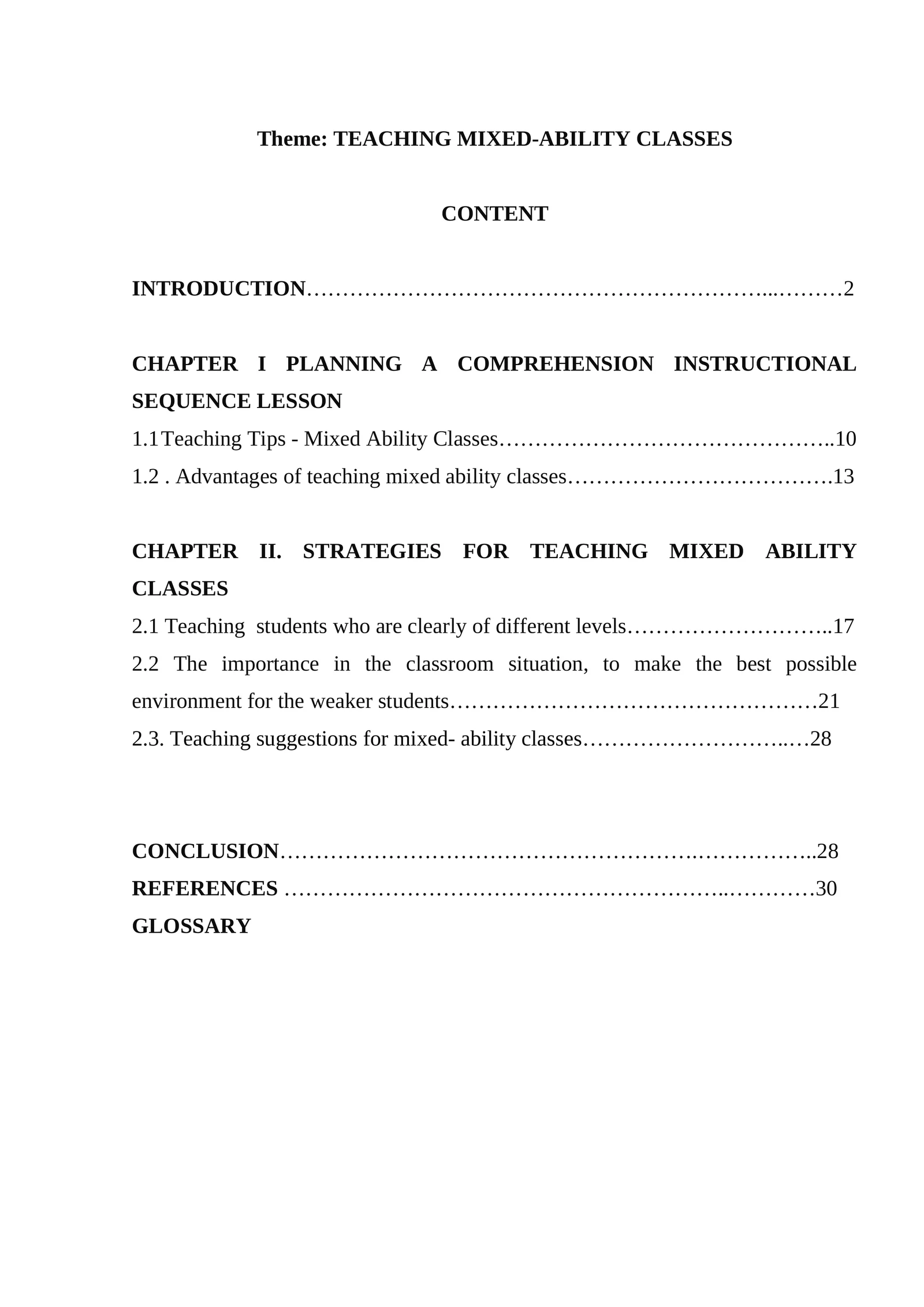
TEACHING SPEAKING IN MIXED-ABILITY CLASSES СONTENT INTRODUCTION…………………………………………………………..…….3 CHAPTER I UNDERSTANDING MIXED-ABILITY CLASSROOMS 1.1. Administer a speaking pre-assessment to gauge students' current speaking abilities…………………………………………………………………………..…6 1.2. Analyze the results to identify students' proficiency levels and create mixed-ability groups……………………………………………………………….8 1.3. Form groups with a balance of high, medium, and low proficiency levels to encourage peer learning…………………………………………………...……12 CHAPTER II ENGAGING ACTIVITIES FOR MIXED-ABILITY SPEAKING CLASSES…………………………………………………….…… 2.1. Assign roles or scenarios to each group, ensuring they are appropriate for their proficiency levels……………………………………………………...…….17 2.2. Provide clear instructions and guidelines for the role-plays or simulations………………………………………………………………………...19 2.3. Encourage higher-proficiency students to take on leadership roles and support their lower-proficiency peers………………………………………..……21 CHAPTER III ASSESSING SPEAKING SKILLS IN MIXED-ABILITY CLASSROOMS…………………………………………………………………… 3.1. Develop rubrics and checklists that align with the speaking skills and sub-skills being assessed………………………………………………………………24 3.2. Clearly define the criteria for different proficiency levels to ensure fair evaluation…………………………………………………………………………26 3.3. Use the rubrics and checklists to assess students' speaking performances during class activities or presentations……………………………………………30 COCNLUSION…………………………………………………………………..33 REFERENCES…………………………………………….…………………….35 INTRODUCTION The decision of the President of the Republic of Uzbekistan "On provision of information and communication technologies and personal education with highly qualified personnel of Uzbekistan, additional support for the development of information technologies, development of scientific technologies and their integration with information and communication technologies [1] " Shavkat Miromonovich Mirziyoyev The relevance of course work Teaching speaking in mixed-ability classrooms presents both opportunities and challenges for educators. In a diverse classroom, students possess varying levels of proficiency, confidence, and language skills, making it crucial to employ effective strategies that cater to the needs of all learners. By adopting inclusive instructional approaches, educators can create an environment that promotes active participation, collaboration, and growth for students of different abilities.The goal of teaching speaking in mixed-ability classrooms is to foster the development of effective oral communication skills, enabling students to express their thoughts, ideas, and opinions confidently. This not only enhances their language proficiency but also equips them with essential skills for interpersonal communication, critical thinking, and collaboration.To ensure successful outcomes, educators must consider the diverse needs of students and implement strategies that address these variations. This includes pre-assessment and grouping techniques to create mixed-ability groups, differentiated instruction to meet individual learners' needs, engaging activities that promote active participation, and effective assessment methods that provide feedback and support growth.This guide will explore various strategies and plans for teaching speaking in mixed-ability classrooms. It will delve into topics such as understanding mixed-ability classrooms, engaging activities for diverse learners, and assessing speaking skills effectively. By incorporating these strategies into their instructional practices, educators can create an inclusive and supportive learning environment that empowers students to develop their speaking abilities, collaborate with their peers, and become effective communicators. Teaching speaking in mixed-ability classrooms requires thoughtful planning, flexibility, and a commitment to meeting the diverse needs of students. The following chapters will provide practical guidance and plans that educators can employ to facilitate the growth and development of speaking skills, ensuring that every student has the opportunity to thrive and succeed in their language learning journey. Mixed-ability classrooms consist of students with varying language proficiency levels, learning styles, and background knowledge. It's important for educators to acknowledge and respect these individual differences. By recognizing the unique strengths and challenges of each student, teachers can tailor their instruction to meet diverse learning needs.Foster a positive and inclusive classroom climate where all students feel safe to express themselves. Encourage a sense of community and respect among students by promoting active listening, empathy, and open-mindedness. Establishing a supportive environment helps build students' confidence and willingness to participate in speaking activities.Tap into students' prior knowledge and experiences to make connections with the speaking topics. This can be done through brainstorming sessions, group discussions, or pre-reading activities. By building on what students already know, educators can create a foundation for meaningful conversations and enhance comprehension.Provide explicit instruction and modeling to demonstrate effective speaking strategies. Clearly explain and demonstrate concepts such as turn-taking, active listening, and using appropriate language functions (e.g., expressing opinions, making requests). Modeling helps students understand expectations and provides them with examples to follow.Incorporate cooperative learning structures that encourage collaboration and peer interaction. Pairing students with different proficiency levels promotes peer learning and creates opportunities for higher-proficiency students to support their peers. Cooperative learning activities, such as pair work or group discussions, enable students to practice their speaking skills in a supportive and interactive setting.Implement a gradual release of responsibility model, starting with more teacher guidance and gradually shifting towards independent student practice. Begin with structured speaking activities and gradually increase the complexity and autonomy of tasks. This approach allows students to develop their speaking skills at their own pace while providing necessary support.Provide language support tools and resources to aid comprehension and expression. This can include visual aids, graphic organizers, sentence [2] frames, or vocabulary banks. These supports can be especially beneficial for students with lower proficiency levels, allowing them to participate more confidently in speaking activities. Use formative assessment strategies throughout speaking activities to monitor student progress and provide timely feedback. This can involve informal observations, checklists, or quick oral feedback. Formative assessment helps teachers identify areas where students may need additional support and allows for timely intervention.By incorporating these additional considerations into their teaching practice, educators can create a more inclusive and effective learning environment for students in mixed-ability classrooms. The key is to embrace the diversity of learners, provide tailored support, and foster a sense of belonging and engagement in speaking activities. CHAPTER I UNDERSTANDING MIXED-ABILITY CLASSROOMS. 1.1. Administer a speaking pre-assessment to gauge students' current speaking abilities. [1] President Of The Republic Of Uzbekistan Sh. Mirziyoyev Tashkent,August 22, 2022, PQ-357 [2] Decision of the Cabinet of Ministers of the Republic of Uzbekistan "On popularizing the study of foreign languages in the Republic of Uzbekistan" 19.01.2022.
Muallif

- Hujjatlari
- 9 645
- Sotilgan
- 3 370