SOFF X · AIHujjatingizni AI yaratsinSovg'ani oling
Mahsulot tavsifi
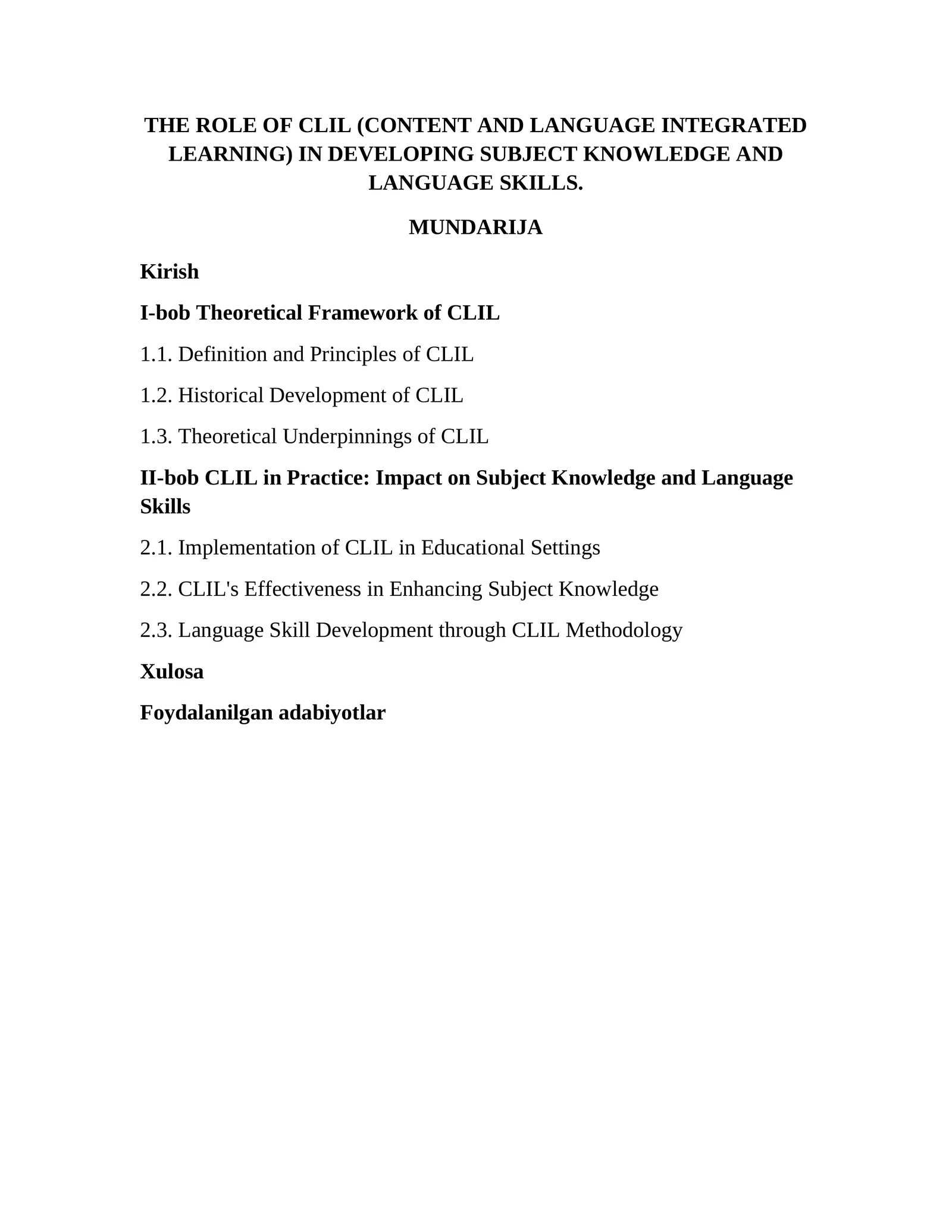
CONTENTS INTRODUCTION .. 3 CHAPTER 1. THEORETICAL FOUNDATIONS OF VOCABULARY DEVELOPMENT IN CLIL .. 5 1.1. Defining CLIL and Its Core Principles 5 1.2. The Nature of Subject-Specific Vocabulary in Content Learning. 7 1.3. Cognitive and Linguistic Challenges in Acquiring Academic Vocabulary. 9 CHAPTER 2. APPROACHES TO TEACHING SUBJECT-SPECIFIC VOCABULARY IN CLIL .. 11 2.1. Integrating Content and Language: The 4Cs Framework (Content, Communication, Cognition, Culture) 11 2.2. Scaffolding Techniques for Vocabulary Development 13 2.3. The Role of Context, Visual Aids, and Multimodal Input 15 CHAPTER 3. PRACTICAL STRATEGIES FOR ENHANCING SUBJECT-SPECIFIC VOCABULARY .. 17 3.1. Task-Based and Content-Driven Vocabulary Activities. 17 3.2. Using Technology and Digital Tools in CLIL Vocabulary Instruction. 19 3.3. Assessment and Feedback Strategies for Vocabulary Acquisition. 21 CONCLUSION .. 23 GLOSSARY .. 25 BIBLIOGRAPHY .. 28 THE INTERNET RESOURCES . 30 INTRODUCTION In the context of modern education, the growing demand for multilingual competence and subject mastery has led to the widespread implementation of innovative teaching approaches. According to the decision of the President of the Republic of Uzbekistan «On measures to bring the activities of popularization of learning foreign languages to a qualitatively new level in the Republic of Uzbekistan» dated May 19, 2021 No. PQ-5117, as well as foreign languages In order to effectively implement organizational measures to popularize learning, the Cabinet of Ministers decides: 1. Decision PQ-5117 dated May 19, 2021 of the President of the Republic of Uzbekistan «On measures to bring the activity of popularizing the study of foreign languages to a qualitatively new level in the Republic of Uzbekistan» [1] . One such approach is Content and Language Integrated Learning (CLIL), which combines subject instruction with foreign language learning. This dual-focused methodology enables students to acquire both content knowledge and language skills simultaneously. Within this framework, the development of subject-specific vocabulary becomes a central component, as it directly affects learners’ ability to comprehend academic material and actively participate in classroom interaction. The relevance of this topic lies in the increasing importance of equipping learners with the linguistic tools necessary for academic success in a globalized world. In CLIL classrooms, students are required not only to understand subject content but also to process and use specialized terminology in a foreign language. However, many learners encounter difficulties in mastering such vocabulary due to its abstract nature, complexity, and context-dependent usage. Therefore, investigating effective ways of developing subject-specific vocabulary is essential for improving both language proficiency and content learning outcomes. The aim of this course work is to examine the process of developing subject-specific vocabulary within the CLIL approach and to identify effective strategies for its implementation in the classroom. In accordance with this aim, the following objectives are defined: to explore the theoretical foundations of CLIL and vocabulary acquisition; to analyze the role of subject-specific vocabulary in content-based instruction; to identify the main cognitive and linguistic challenges faced by learners; to examine effective teaching approaches and techniques used in CLIL contexts; to develop practical recommendations for enhancing vocabulary instruction. The object of the research is the process of teaching and learning through the CLIL approach. The subject of the research is the methods and strategies for developing subject-specific vocabulary in CLIL classrooms. The practical significance of this study lies in its applicability to real educational settings. The results of the research can support teachers in designing effective lessons that integrate language and content, as well as in selecting appropriate techniques for vocabulary instruction. Furthermore, the study may contribute to improving students’ academic language proficiency and overall learning performance. The structure of the course paper consists of an introduction, three main chapters, a conclusion, a glossary, and a list of references. The first chapter discusses the theoretical foundations of vocabulary development in CLIL. The second chapter focuses on teaching approaches and methodological frameworks. The third chapter presents practical strategies for enhancing subject-specific vocabulary. The paper concludes with a summary of findings and suggestions for further research. [1] Decision PQ-5117 dated May 19, 2021 of the President of the Republic of Uzbekistan «On measures to bring the activity of popularizing the study of foreign languages to a qualitatively new level in the Republic of Uzbekistan»
Muallif

- Hujjatlari
- 854
- Sotilgan
- 305